Short report submitted to English Heritage, 5 July 2001
This research project supported by the Centre for Research on Human Rights, Sheffield Hallam University
All text and photographs copyright © J. Blain and R.J. Wallis, 2001
We submit this short report on the understanding that English Heritage are seeking comments on this year's summer solstice open access at Stonehenge. We are an anthropologist and an archaeologist undertaking study of meanings and uses of 'sacred sites’ in Britain today, with particular emphasis on understandings derived from 'alternative', often pagan, groups or spiritualities. As has been noted in a variety of English Heritage documents relating to other sites, at last year's ASLaN conference, and in our own work (e.g. Wallis 1999, 2000; Blain 2000; Wallis and Blain 2001, and see Pitts 1996), paganism is an extremely fast-growing sector of today's post-modern Britain, with pagans increasingly visiting ancient monuments and treating these as 'sacred sites'. Indeed, pagans are likely to be frequent visitors, returning to sites, and the non-monolithic nature of paganism (or more correctly 'paganisms') indicates a wide range of possible relationships with sites, understandings of 'sacredness', and ideas about how sites are to be 'used'.
Our work is currently funded by a grant from the Centre for Research on Human Rights, Sheffield Hallam University. Our observation and interviewing at Stonehenge this year forms part of this funded research and will act, we intend, as a pilot for a wider study of sites. Our work dealing with meanings of Stonehenge (and the solstice sunrise in particular) is ongoing, building upon earlier observations by Wallis in 1999 and Blain in 2000, and in the available literature (e.g. Bender 1993, 1998; Bender & Edmonds 1992; Chippindale 1985, 1986; Chippindale et al. 1990; Craig 1986; Golding 1989; Hetherington 1992a, 1992b; NCCL 1986; Wallis & Lymer 2001), and on discussions with colleagues and with long-standing campaigners and advocates of various possibilities for access.
Main observations from this year include:
Amongst others, we spoke to travellers, 'pagans' of many descriptions (including druids, wiccans, witches, heathens and others), people involved with the festivals in the 1970s, those who had come because it was something to attend and seemed interesting, performers (street theatre performers, fire-dancers, drummers), tourists, academic scholars from Britain and overseas, and various others who were observing the event. Not all attendees were pagan, though many expressed some interest in paganism and/or wider spiritual beliefs. Not all were aware of or complied with the restrictions (dogs, glass [although the provision of plastic drinks canisters in exchange for glass was again successful], fire, etc.). However, those people who spoke to us seemed to have some awareness of the recent history of the site, and some at least had come specifically to support the open access policy.
(In stating that not all were pagan, it is however worth pointing out that many of the pagans did not 'look pagan': most were wearing jeans or other clothes suitable to a cool summer's night. Conversely, some who were dressed differently or 'strangely' were there as performers. Pagans, for the most part, look like anyone else.)
Approaches to the Stones ranged from tourists examining a strange British ritual of identity, to those of the thousands of people who were indeed constructing identity – as individuals and as groups – in defining their relationship to the Stones. Anthropologically, this identity focus is extremely interesting and we are only beginning to analyse our participant-observation and interview material: for this report it is sufficient to say that the Stones and their (whether assumed or researched) history and prehistory form an important part of many people's concept of self, place and belonging – but do so differently for each person.
For instance: some participants in the 1970s festivals spoke of how the stones had come, for them, to symbolise 'freedom'. The concept of a free festival and open access, therefore, was centrally important for them as a goal in itself. For many pagans the stones had inherent power, or the ground on which they had been placed had this power, so that free access was for them a means to an end, and the rising of the sun to shine onto the stones was a sacred or holy moment. For some in both of these groups, the stones were a place where people in the past (the un-named builders) had held social events, and at this solstice several handfastings (pagan weddings) and child-namings were performed. A leading campaigner linked past and present in saying that there had been a void in the lives of many people – now filled as they could return to help their weddings and child-blessings.
Almost all comments and discussions with people at Stonehenge focused on the stones themselves. Awareness of the surrounding landscape seems fairly low. A leading druid commented to us on the active nature of people's engagement with the monument:
Stonehenge wasn't built as a museum. It was built as place for people to come, for worship, to use it.
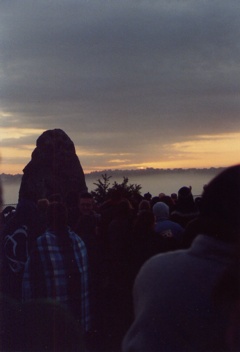
Such use, in his view, includes spiritual and social purposes, and indeed he emphasised that 'partying' can be spiritual also. Uses included drumming, dancing, and other forms of partying; and also waiting quietly, amidst the partying, for the sun to appear. The night was enlivened by the King's Drummers and their torchlight entertainment, as well as by the general partying atmosphere of those who did not express spiritual interests. It is worth noting that while the 'festival', primarily, has been excluded in the past (e.g. at the 1999 ticket-only solstice access) it is now the more obviously 'spiritual' component (as opposed to 'spiritual partying') that is currently excluded due to a 'party' monopoly. More evidently spiritual uses, during the long period of dawn particularly, included an impromptu ceremony involving a large cymbal taking place near the heelstone, a Maori choir, and the large crowd of people who gathered facing the heelstone as the sky lightened in dawn.
Here however lies a point of conflict: the lighting policy of English Heritage may have served to illuminate the area of the stones (though people pointed to problems with the extreme brightness saying 'I can't see' or 'we're falling over'), but it also resulted in the only conflict observed during the night:
A number of uses hold potential conflicts: most obviously, attempting to perform ritual within the stones holds little interest for many attendees (including some pagans) and short, small-scale ritual events probably make more sense than attempts to involve people in traditions which are not their own. There is the ongoing problem of early-comers remaining in the centre all night, with apparently little to draw them out. Some people, however, preferred to remain in the car park and play loud music, reflecting how some attendees are more interested in a 'party' than access to Stonehenge. The acoustic-music only policy is a good one, with the piping and percussion adding to the occasion for most people we spoke to, but in the future the issue of a non-acoustic 'party' – a suitable distance from Stonehenge of course – may need to be addressed. Without doubt, there are difficult issues of people management here, but music events at a distance, along with small-scale ceremonies on-site and/or around the landscape, would possibly ease the pressure on the centre.
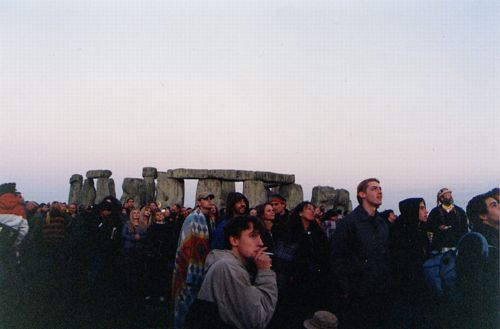
The physical impact of such an event on Stonehenge, particularly the centre, is of course very difficult to assess. We think it worth recording that given the huge numbers this year (estimated 14000), there is no reported damage. It is clear that some people, but by no means all, are going to want to sit and stand on fallen stones, and achieve this, regardless of policy, due to sheer pressure of numbers inside the stones. Many of those that did, responded favourably to requests from 'green stewards' to remove their shoes to minimise impact. This approach seems to work best when implemented in a reactive rather than proactive manner, the latter being more likely to encourage such engagement (i.e. people told in advance not to stand on fallen stones may make a point of doing so, but if asked politely to remove shoes, will often comply). Interestingly, the crowd draws a clear distinction between this and the few attempts to reach the lintels, which were met, for the most part, with extreme disapproval: an example of 'self-policing' at work. Sometime after dawn however, as people began leaving, there was noticeably no 'green' security presence at the centre and one or two more people again attempted to climb the stones (though they did not reach the lintels).
We feel that, first, congratulations are due to those involved in the negotiations and planning – from heritage, police and pagan and other communities – for the overall success of this year's event. The monument is important to many people in many ways, and this event, following on from last year's, displayed that importance and displayed also the very large measure of respect that is growing between most participants in the negotiations (which is why the incidents involving lighting were particularly unfortunate). At this very preliminary level of analysis we emphasise:
We also wish to see these questions surrounding use of Stonehenge debated in other forums. For instance, these interactions and the multiplicity of meanings, for people today, of Stonehenge as a 'sacred site' does not appear in any literature on Stonehenge, such as the Stonehenge World Heritage Site Management Plan (English Heritage 2000) and Frameworks for our Past (Oliver 1996). Stonehenge is an 'icon of Britishness', and use of its image, in many contexts, has been commented on widely. Here we have people actively engaging with the site to create new meanings, within contexts which are social, spiritual, and political. There is much room for debate: academically, of how these meanings emerge; culturally and spiritually, of their contribution to British life today; archeologically, on the extent and implications of non-academic intellectual and physical engagement; and politically, on implications for pluralist post-modern Britain. The negotiations around the revived Stonehenge solstice event are of importance and value far beyond the thousands who are able to attend.
Bender, B. 1993. Stonehenge - Contested Landscapes (Medieval to Present Day). In: B. Bender (ed.) Landscape, Politics and Perspectives: 245-280 Oxford: Berg.
Bender, B. 1998. Stonehenge: Making Space. Oxford: Berg.
Bender, B. and M. Edmonds. 1992. De-Romancing the Stones. The Guardian 15th June.
Blain, J. 2000. '"Old Religion", new conflicts: Newspapers, nationalism and the politics of alternative spirituality'. International Conference on Cultural Studies, Birmingham, June 2000.
Chippindale, C. 1983. What Future for Stonehenge? Antiquity 57:172-180.
Chippindale, C. 1985. English Heritage and the Future of Stonehenge. Antiquity 59: 132-137.
Chippindale, C. 1986. Stoned Henge: Events and Issues at the Summer Solstice, 1985. World Archaeology 18(1): 38-58.
Chippindale, C.; Devereux, P.; Fowler, P.; Jones, R.; and T. Sebastian. 1990. Who Owns Stonehenge? Manchester: Batsford.
Craig, S. (ed.). 1986. Stonehenge '85: Souvenir Issue – A Collection of Material to Commemorate 'The Battle of the Beanfield' June 1st 1985. Glastonbury: Unique Publications.
English Heritage. 2000. Stonehenge World Heritage Site Management Plan. London: English Heritage.
Golding, F.N. 1989. Stonehenge – Past and Future. In: Cleere, H. F. 1989. (ed.) Archaeological Heritage Management in the Modern World: 265-271. London: Routledge.
Hetherington, K. 1992a. Place, Space and Power: Stonehenge and the Travellers. Here and Now 12: 25-28.
Hetherington 1992b. Stonehenge and its Festival: Spaces of Consumption. In: R. Shields (ed.) Lifestyle Shopping: The Subject of Consumption. London: Routledge.
NCCL (National Council for Civil Liberties). 1986. Stonehenge: A report into the civil liberties implications of the events relating to the convoys of summer 1985 and 1986. London: Yale.
Oliver, A. 1996. Frameworks for Our Past: A Review of Research Frameworks, Strategies and Perceptions. London: English heritage.
Pitts, M. 1996. The Vicar's Dewpond, the National Trust and the Rise of Paganism. In: Morgan, D.; Salway, P. and D. Thackray (eds) The Remains of Distant Times: Archaeology and the National Trust: 116-131. Woodbridge, Suffolk: The Boydell Press for the Society of Antiquaries of London and the National Trust.
Wallis, R.J. 1999. Autoarchaeology and Neo-shamanism: The Socio-Politics of Ecstasy. PhD Thesis, Department of Archaeology, University of Southampton. Submitted November 1999.
Wallis, R.J. 2000. Queer Shamans: Autoarchaeology and Neo-shamanism. World Archaeology 32 (2): 251-261.
Wallis, R.J. and Blain, J. 2001. 'Sacred' sites, contested rights: contemporary Pagan engagements with ancient sites and their implications for 'the condition of heritage'. 4th Cambridge Heritage Seminar: 'The Condition of Heritage'. McDonald Institute, Cambridge, 19.4.2001.
Wallis, R.J. and K. Lymer 2001 (eds) The Permeability of Boundaries debate: 'Alternative Archaeology' – has it happened? In: R.J. Wallis and K. Lymer (eds) A Permeability of Boundaries? New Approaches to the Archaeology of Art, Religion and Folklore: 105-124. BAR International Series 936. Oxford: British Archaeological Reports.
All text and photographs copyright © J. Blain and R.J. Wallis, 2001.
Contact:
Dr Jenny Blain
[email protected] jenny.blain@freeuk.com
0114 225 4413 07976 170812
Course leader, MA in Social Science Research Methods
Senior Lecturer in Sociology, School of Social Science and Law
Collegiate Crescent Campus, Sheffield Hallam University, Sheffield S10 2BP
Dr Robert J. Wallis
rjw2@soton.ac.uk
02380 592911 07779 037269
Lecturer in Archaeology, Department of Archaeology
University of Southampton
Avenue Campus, Highfield, Southampton SO17 1BJ
| sacred sites home |
news & press releases |
discussion documents |
reports & statements |
papers & articles |
specific sites |
photo gallery |
links |
email us |
book shop | J. Blain webpages |